





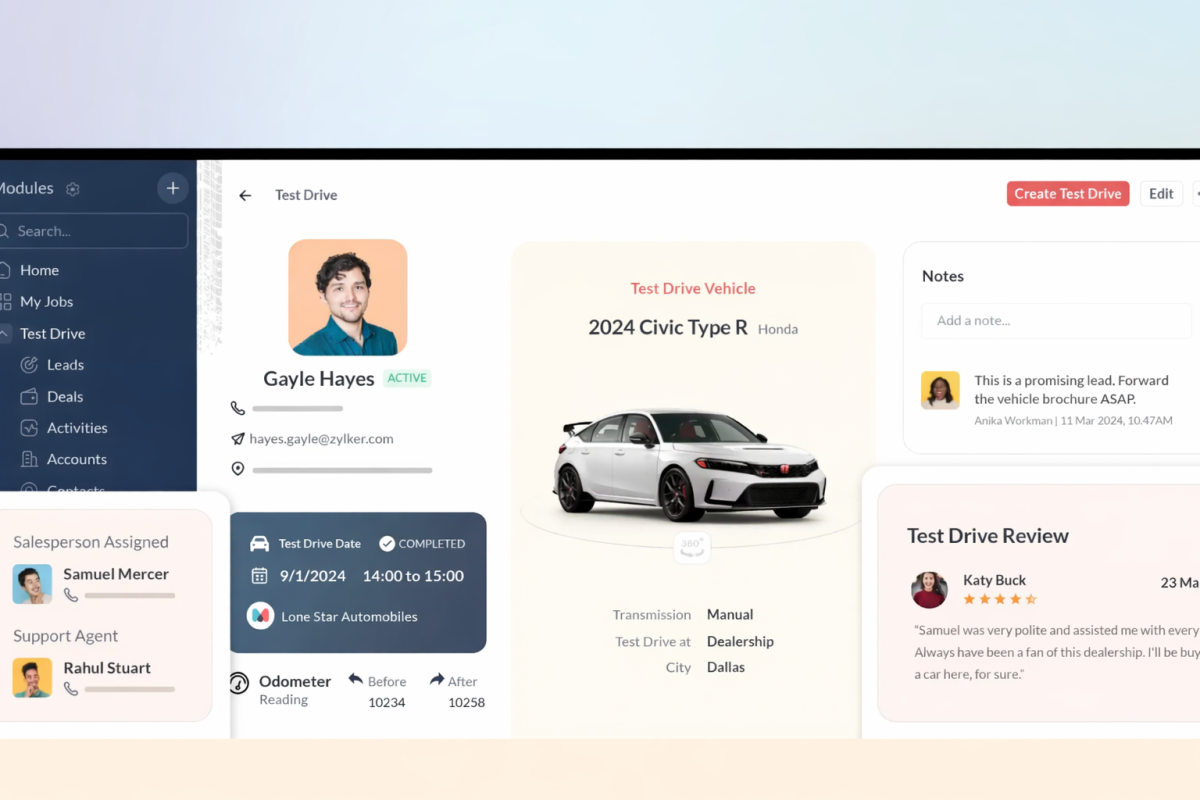
What is Zoho CRM? It is not just a customer management software, but a system that enables businesses to control the entire journey from opportunity to revenue.
In many organizations, when revenue stagnates, the first instinct is to look at marketing or the sales team. Marketing believes they are generating enough leads, while sales argues that the leads are not qualified or not ready to buy. However, when you analyze deeper into how the business operates, you will realize that the real issue does not lie in people, but in the company’s inability to systematically control the customer journey. Customers come and go without anyone understanding why, sales opportunities appear and disappear without clarity on where they are stuck, and the entire conversion process becomes fragmented, lacking data and impossible to measure.
This is exactly the context where CRM becomes a core component of the operating system. And Zoho CRM is one of the platforms designed to directly solve this problem.
What is Zoho CRM?
Zoho CRM is a cloud-based Customer Relationship Management (CRM) software that enables businesses to manage their entire sales, marketing, and customer service activities within a single system. However, if CRM is only understood as a place to store customer information, that understanding is incomplete. The true nature of CRM is not about storing data, but about helping businesses control the conversion process from opportunities into revenue.
With Zoho CRM, businesses can clearly see which stage a customer is in within the buying journey, understand why they have not yet made a decision, and estimate the probability of conversion. This allows companies not only to manage current activities, but also to forecast future revenue based on real data.
How does Zoho CRM really work in practice?
At the core of Zoho CRM’s operation is the concept of a pipeline, also known as the sales flow. Instead of viewing revenue as a final outcome, businesses begin to see it as a sequence of measurable and controllable steps, from lead generation, consultation, quotation, negotiation, to closing the deal. Each customer is placed at a specific stage within this pipeline, and the system reflects the real-time status of business activities.
The key difference is that businesses are not only aware of what is happening in the present, but can also predict what will happen in the future. For example, if a large number of opportunities are concentrated at the quotation stage, the business can estimate conversion rates and forecast upcoming revenue. This is something fragmented tools like Excel or personal notes cannot achieve, as they do not create a cohesive and logical system.
Core Features of Zoho CRM
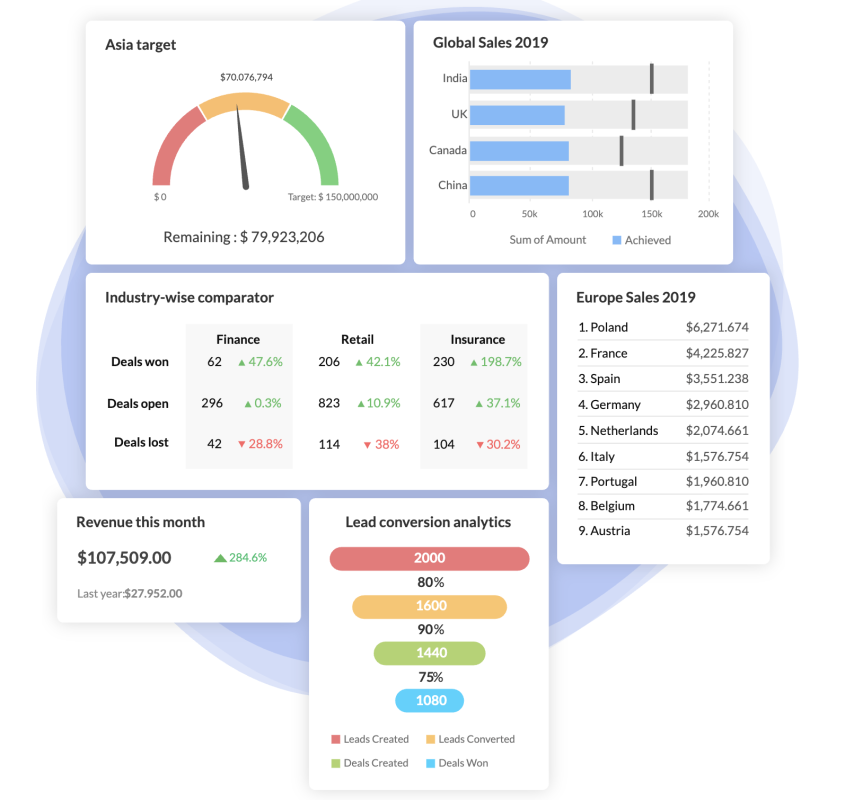
Zoho CRM provides a comprehensive set of features focused on standardizing and automating the entire sales process. One of its key capabilities is sales automation, which allows the system to automatically assign leads, send emails based on predefined workflows, and update deal statuses without manual intervention. This helps reduce the workload for sales teams and significantly improves processing speed.
In addition, the platform integrates an AI assistant called Zia, which can analyze data, forecast revenue, suggest optimal times to engage with customers, and support upselling or cross-selling activities. Zoho CRM also offers omnichannel communication management, enabling businesses to track all customer interactions across email, phone, live chat, and social media within a single interface.
The reporting and analytics system is another major strength, allowing businesses to evaluate sales team performance, measure marketing effectiveness, and monitor conversion rates at each stage of the pipeline. Notably, Zoho CRM is highly customizable, making it adaptable to various business models, from small companies to large-scale enterprises.
Benefits of Using Zoho CRM for Businesses
One of the biggest advantages of Zoho CRM is its ability to centralize all customer data into a single system, creating a 360-degree view accessible to all departments. This ensures consistency of information across marketing, sales, and customer service, while eliminating data fragmentation.
In addition, having a clearly structured pipeline with automated reminders helps businesses avoid missing opportunities, significantly improving conversion rates. With built-in analytics and forecasting capabilities, companies can make decisions based on data rather than intuition, leading to more stable and controllable growth.
When Do Businesses Need Zoho CRM?
Many businesses delay implementing a CRM system because they believe they are still able to generate sales. However, the real issue is not whether they can sell, but whether they truly understand how their sales process works. If you have multiple lead sources but cannot identify which ones are effective, if your sales team performs inconsistently, or if you are unable to forecast future revenue, these are clear signs that your business lacks a proper control system.
Zoho CRM is especially suitable for businesses in a growth phase, where the volume of customers and opportunities begins to exceed manual management capacity. At this stage, implementing a CRM is no longer just an optimization choice, but a necessary step to sustain and scale business operations.
The Role of Zoho CRM in the Business System
Zoho CRM does not operate in isolation; it serves as the central hub of the entire operational system. Marketing is responsible for generating leads, the CRM stores and organizes customer data, the sales team engages and converts, and all collected data is then used to continuously optimize marketing activities. Without a CRM, the entire customer journey becomes fragmented, and the business loses its ability to learn from its own data.
Conclusion
Zoho CRM is one of the most popular and powerful CRM platforms today, but its real value lies not in its features, but in how it enables businesses to control their revenue. When sales processes are standardized, data is centralized, and all activities are measurable, businesses can operate more efficiently and achieve sustainable growth.
If the Zoho ecosystem is viewed as an overall platform, then Zoho CRM is where revenue is created, tracked, and optimized. In an increasingly competitive landscape, controlling the customer journey is no longer a competitive advantage, it is a fundamental requirement for survival and growth.