





Both Zoho Bigin and Excel are familiar tools used by many schools, language centers, skills training centers, and educational institutions to manage student admissions. However, as organizations grow, student numbers increase, and admissions processes become more complex, choosing the right tool has a direct impact on operational efficiency. So, when does it make sense to continue using Excel, and when should an organization move to a Mini CRM to optimize costs while improving admissions management?
Zoho Bigin vs Excel: Excel Is Still a Great Starting Point for Many Education SMEs
There is no denying that Excel is often the first tool educational organizations adopt when they begin operating. Student lists, parent information, class schedules, and admissions records are commonly stored in familiar spreadsheets.
Excel’s strengths lie in its ease of use, affordability, flexibility, and the fact that almost every employee already knows how to use it. For newly established training centers with relatively few students and straightforward processes, Excel can effectively handle basic management needs.
The question, therefore, is not whether Excel is a good tool. The real question is whether it remains the right tool as the organization enters a new stage of growth.
As the Admissions Process Expands, Excel Begins to Show Its Limitations
When a training center has only one or two admissions consultants, managing data with spreadsheets remains relatively convenient. However, as the number of prospective students grows each day, multiple courses are offered simultaneously, and the admissions team expands, organizations begin facing challenges that Excel was never designed to solve.
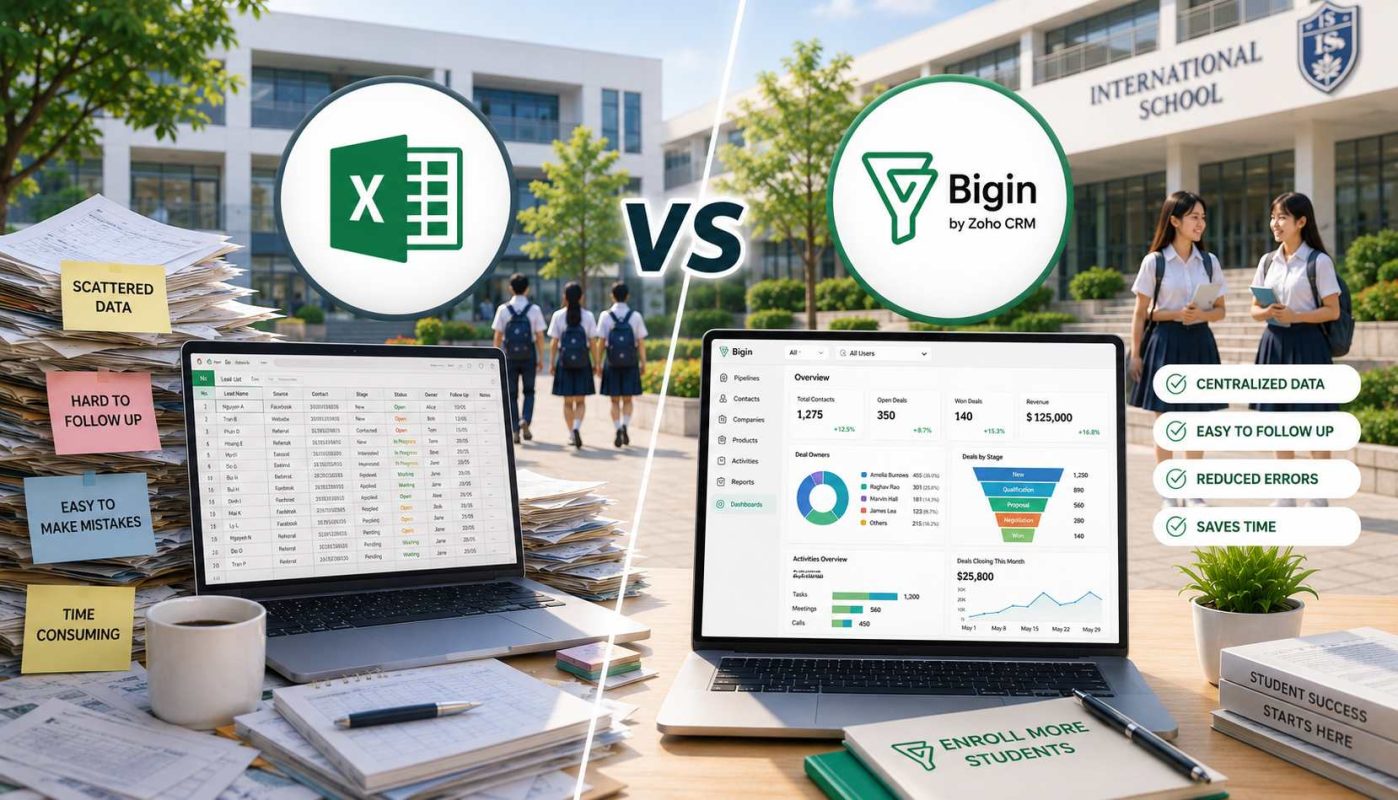
Student information often becomes scattered across multiple spreadsheets or separated by individual staff members. Communication history with parents is not stored centrally, resulting in situations where multiple consultants contact the same family or, conversely, no one follows up at all. Tracking where each prospective student is within the admissions journey also depends entirely on manual updates.
When managers need to review conversion rates between admissions stages, the number of students waiting for consultation, or the performance of each admissions consultant, the data usually has to be consolidated manually, consuming significant time and effort.
At this point, the organization no longer lacks data. Instead, it lacks a system capable of organizing and leveraging that data more effectively.
Zoho Bigin vs Excel: Comparing Them Across Admissions Challenges
From an operational perspective, Excel and a Mini CRM are not direct competitors designed to replace one another. Each solution serves a different stage of an organization’s growth.
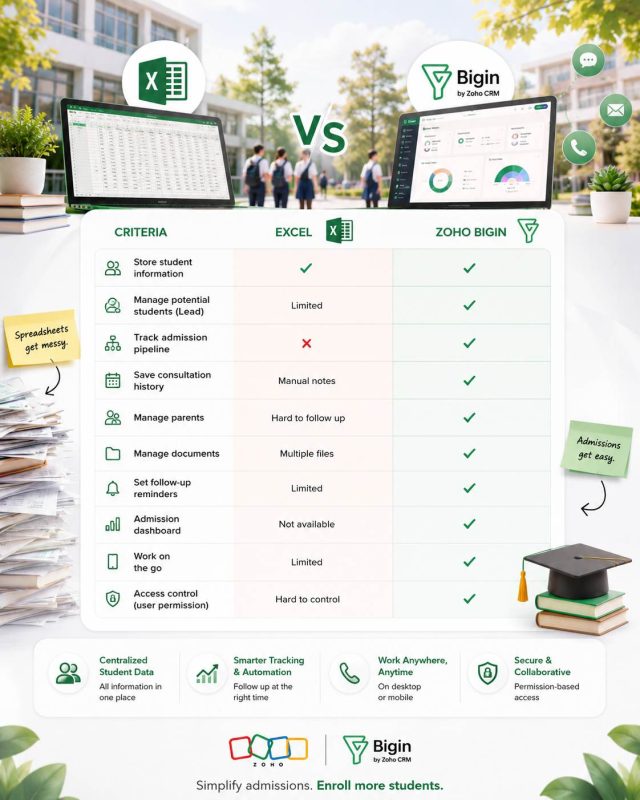
The biggest difference is not the number of features, but how data is managed. While Excel primarily stores information, a Mini CRM enables organizations to track the entire admissions journey, from the moment a prospective student submits an inquiry until enrollment is completed.
What Should a Mini CRM for Education Provide?
When comparing Zoho Bigin and Excel for admissions management, the real difference lies not in feature quantity but in the ability to standardize operational workflows. Many organizations assume that a CRM is a complex system packed with hundreds of features. In reality, education SMEs primarily need tools that directly support their daily admissions and student service activities.
A suitable Mini CRM should enable organizations to manage all prospective students within a centralized visual pipeline. Instead of searching through multiple spreadsheets, admissions teams can easily track every prospect through stages such as consultation, demo session, registration, and enrollment using simple drag-and-drop actions.
At the same time, the system should maintain complete student profiles, parent information, enrolled courses, and interaction histories, allowing any team member to continue the admissions process without disrupting the customer experience.
For institutions offering multiple training programs, managing course catalogs directly within the CRM also significantly reduces administrative effort and minimizes errors during consultations.
In addition, work schedules, phone calls, emails, appointments, and student follow-up activities should all be managed on the same platform to ensure that no admissions opportunity is overlooked.
Finally, a centralized dashboard enables management to quickly monitor the number of prospective students at each stage, evaluate admissions performance by consultant, and analyze overall conversion trends without manually compiling reports.
Admissions Management Becomes More Structured with a Mini CRM
One of the biggest changes when moving from Excel to a Mini CRM is that organizations begin managing processes rather than simply managing data. A typical admissions journey can be tracked through stages such as:
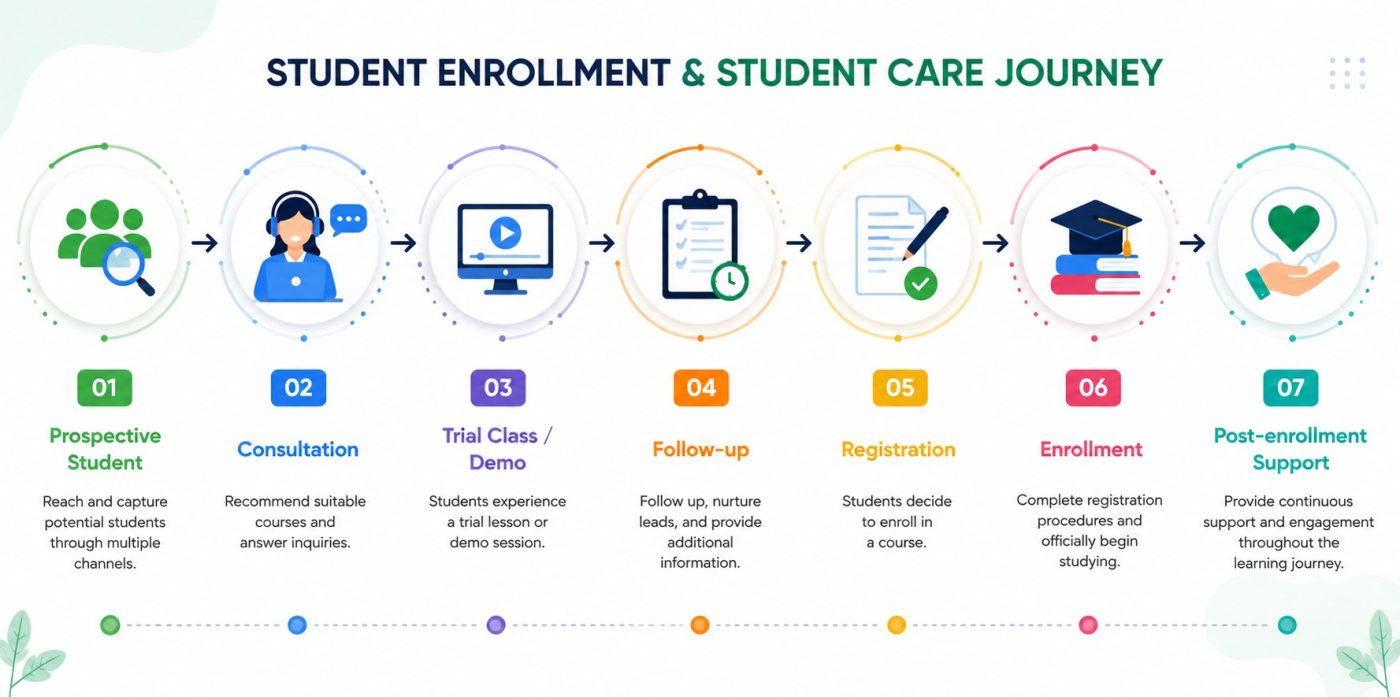
At every stage, the system records work history, assigned staff, processing time, and completed activities. This allows managers to identify exactly where prospective students are in the pipeline, which stage has the lowest conversion rate, and which admissions consultants may need additional support.
Instead of relying on individual memory, the entire admissions workflow becomes standardized and transparent. This is one of the clearest distinctions between Zoho Bigin and Excel: one manages information, while the other manages the complete admissions process.
When Should Education SMEs Move from Excel to a Mini CRM?
There is no universal threshold, but organizations should seriously consider implementing a Mini CRM when they begin experiencing situations such as:
- Having two or more admissions or enrollment consultants.
- Student information being stored across multiple spreadsheets or platforms.
- Frequently missing scheduled follow-up calls or parent nurturing activities.
- Wanting to monitor admissions KPIs by individual consultant.
- Managing multiple courses simultaneously.
- Needing instant admissions reports without manual data consolidation.
- Planning to standardize processes before expanding operations or opening additional campuses.
When an organization experiences several of these challenges, it is usually a sign that Excel has reached its practical limits for operational management. Rather than focusing only on the initial investment cost, organizations should evaluate their admissions volume, student numbers, internal collaboration processes, and future growth plans to determine whether Excel remains sufficient or whether it is time to adopt a Mini CRM such as Zoho Bigin.
Zoho Bigin: A Practical Mini CRM to Begin Your Digital Transformation
Among today’s Mini CRM solutions, Zoho Bigin has become a popular choice for educational organizations because of its fast implementation, intuitive interface, and focus on essential business operations rather than overwhelming users with unnecessary complexity.
Zoho Bigin enables organizations to build admissions pipelines for every enrollment stage, manage students and parents within one centralized platform, maintain complete communication histories, organize course information, monitor admissions team activities, and provide dashboards that give managers a comprehensive view of operational performance.
In addition, the platform supports mobile access, email integration, calendars, and many commonly used business applications, allowing admissions teams to manage their work from virtually anywhere.
For education SMEs, this provides an effective starting point for digital transformation without requiring the immediate investment of a large-scale CRM or ERP system.
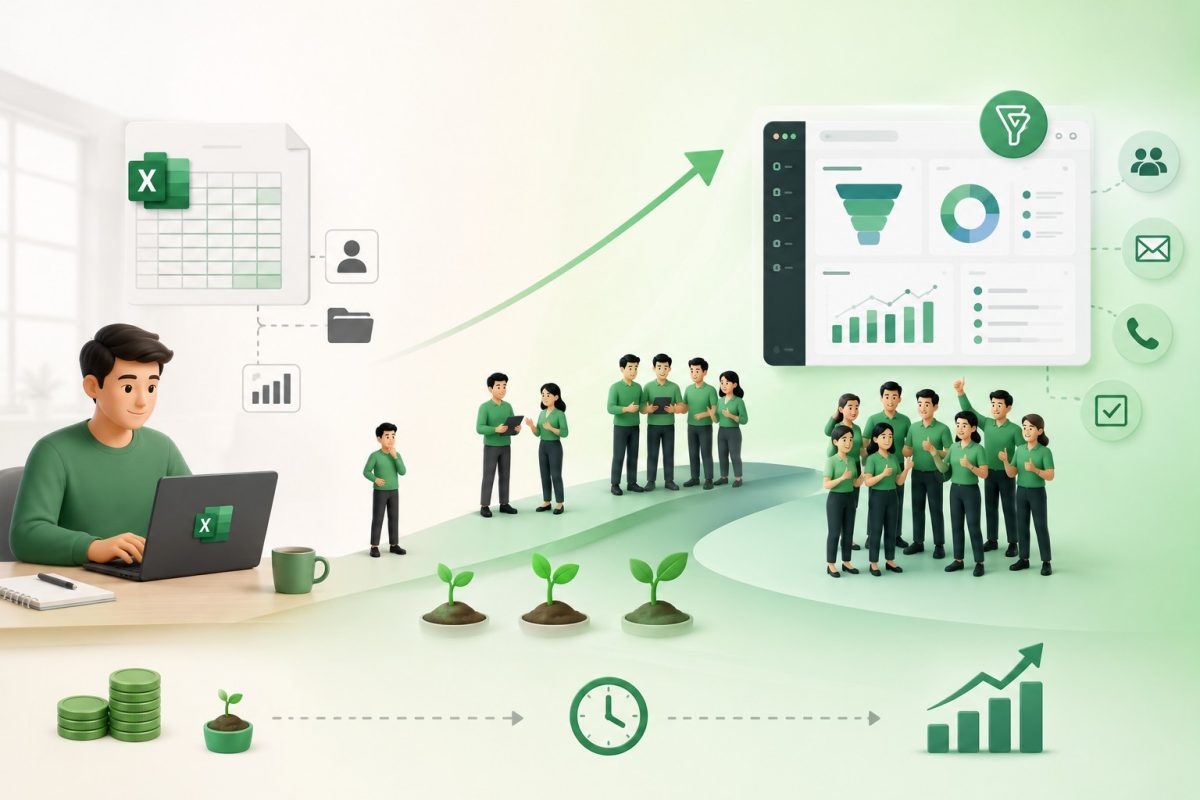
Zoho Bigin and Excel are not competing solutions where one is right and the other is wrong. Instead, they are tools designed for different stages of organizational growth. Excel remains an effective option for smaller organizations with simple workflows. However, as student data grows, admissions teams expand, and management requirements become more sophisticated, a Mini CRM enables organizations to save time, standardize processes, and significantly improve admissions performance.
At WBL Group, we work alongside schools, language centers, and educational institutions to evaluate their current operations, build practical digital transformation roadmaps, and implement CRM solutions tailored to each stage of business growth. If your organization is looking for a platform that is easy to implement, cost effective, and fully capable of supporting your admissions management needs, Zoho Bigin is an excellent place to begin your digital transformation journey.