





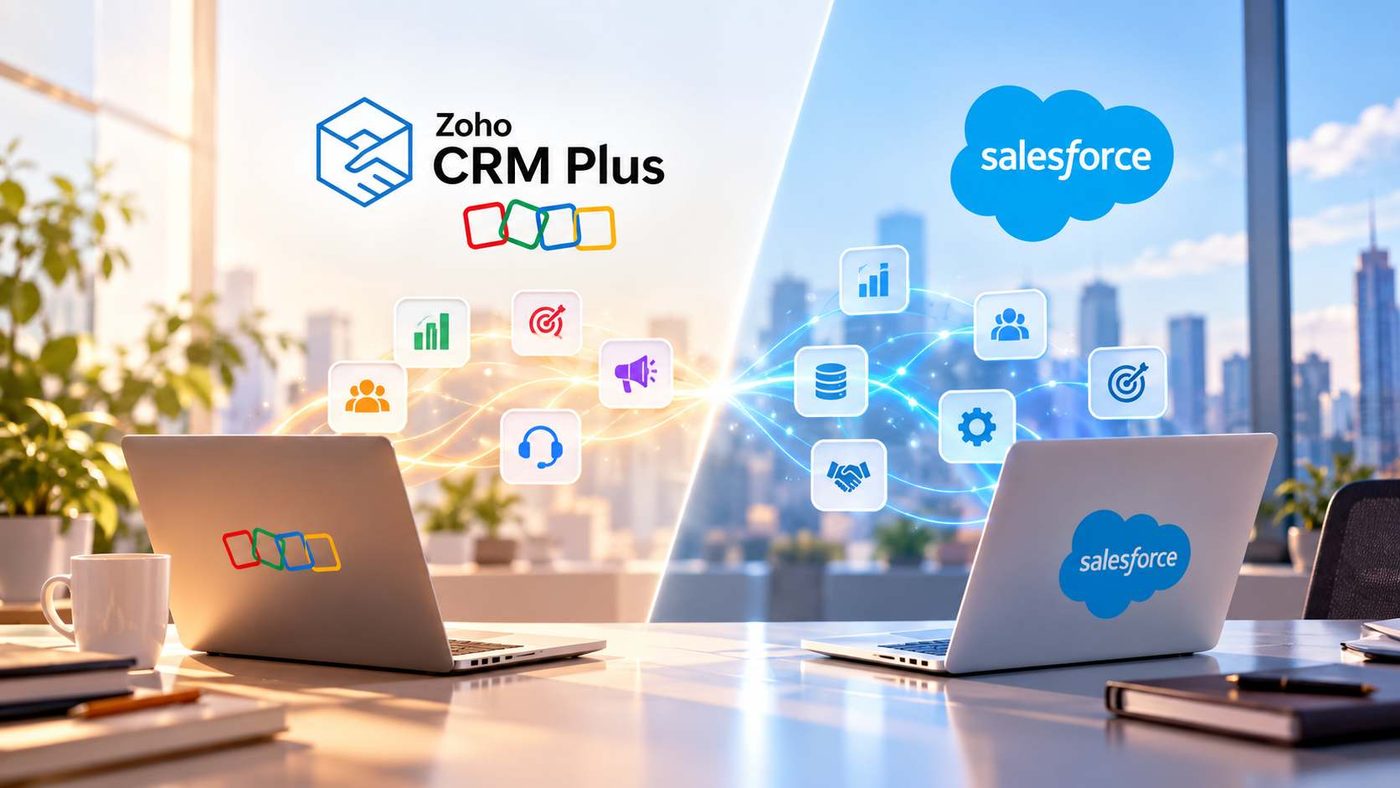
Zoho CRM Plus and Salesforce are both designed to connect customer data, Sales, Marketing and Service on a broader platform than traditional CRM. But when applied to real business needs, what businesses need to compare is not only the number of features, but also how well the platform fits their resources and level of operational complexity.
Is the Business Optimizing Software or Optimizing Resources?
When businesses choose a CRM, the questions often start with features: Does the system manage Leads? Does it support automation? Does it provide reports? Can it integrate with other tools? But for SMEs and Enterprises, the same feature can create very different value because the resources required for implementation and operation are also different.
The broader the platform, the more time the business needs to spend on configuration, user training, data management and maintaining processes. Therefore, the actual cost of a system does not only come from licensing fees, but also from the human resources and level of complexity the business has to manage.
This is an important perspective when comparing Zoho CRM Plus and Salesforce. Neither is simply a CRM. Both extend into multiple activities around the customer, but the way each platform builds its ecosystem and the extent to which it can be expanded have some notable differences.
Zoho CRM Plus: Bringing Multiple Tools Together on One Platform
Zoho CRM Plus is built around the idea of bringing together activities related to customer experience. The suite combines CRM with tools for Marketing, Customer Service, analytics, project management, social media, surveys and customer interactions across multiple channels.
One notable point is how Zoho CRM Plus packages its ecosystem. Businesses can manage multiple tools from a shared administration interface, using a consistent experience instead of having to manage each application as a completely separate system. Zoho also allows user permissions to be assigned based on individual tools and roles, rather than requiring all employees to use the entire system.
This is particularly relevant for SMEs looking to expand from CRM to a broader customer management system while still needing to control implementation resources. Instead of building each component separately and connecting them later, businesses can start with their key needs and gradually expand within the same ecosystem.
The value of Zoho CRM Plus therefore lies largely in its integration: Sales, Marketing and Service can view customer data and coordinate on one platform, while the business can still manage users and tools from a central point.
Salesforce: A Broad Ecosystem for Complex Business Needs
Salesforce approaches the challenge at a very broad scale through its Customer 360 ecosystem, connecting Sales, Service, Marketing, Commerce and various other products and data platforms. Salesforce also currently offers packages for small businesses, while higher tiers are designed for more complex needs around automation, customization, integration and administration.
An important point is that Salesforce is not a single system with every function included in one fixed package. Clouds such as Sales Cloud, Service Cloud, Marketing Cloud and Commerce Cloud can be used independently and connected when the business needs to share data.
This approach creates significant flexibility for businesses with complex processes and deep expansion needs. Salesforce offers product tiers with increasing levels of customization, automation and scalability; at the Enterprise level, the platform is designed for businesses with more complex management requirements.
Therefore, when looking at Salesforce in an Enterprise context, the story is not only about CRM. The ecosystem can expand into Sales, Service, Marketing, Commerce, data, analytics and many other platforms to support larger operating models.
The Comparison Is Not About the Number of Features
If businesses only look at feature lists, comparing Zoho CRM Plus and Salesforce can easily become a feature-counting exercise. But for a business, the more important question is how many resources each platform requires to create real value.
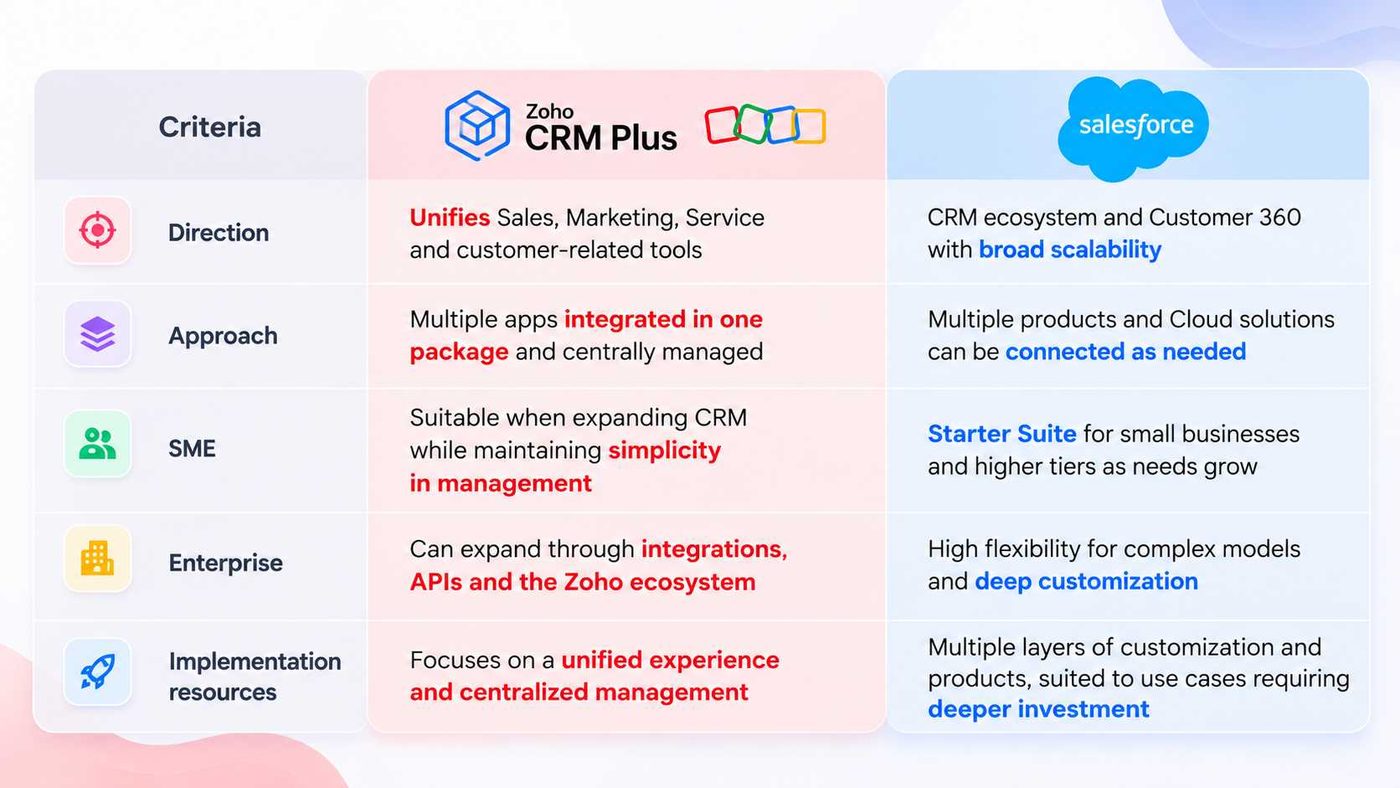
The information above reflects how the two companies currently position their products and should not be interpreted to mean that one platform is only for SMEs while the other is only for Enterprises. Salesforce currently has products for small businesses, while Zoho CRM Plus is also positioned for organizations with customer experience management needs at larger scales.
The practical difference lies in the level of complexity the business needs to handle and the resources the business is prepared to dedicate to the system.
Choose a Platform Based on Resources, Not Brand Name
For SMEs, the challenge is often how to gain sufficient capabilities to manage customers, Marketing and Service without creating an overly heavy system for the team. In this case, a platform with a high level of integration, centralized management and the ability to expand according to business needs can help the business better control implementation resources.
For Enterprises, the challenge can be different. When a business has multiple entities, complex processes, deep customization requirements and needs to connect multiple systems, scalability and control over the technology architecture may be more important than initial simplicity.
Therefore, the question “Zoho CRM Plus and Salesforce, which platform is better?” is not actually the most appropriate question. Businesses should start with more specific questions: How complex are the current processes? How many departments need to use the data? How many internal resources can the team dedicate to implementation? And how far does the business want the system to develop over the next few years?
A suitable platform is not the one with the most features, but the one that creates value proportionate to the resources the business has to invest in operating it.
This is also the perspective WBLGroup uses when evaluating Zoho CRM Plus and Salesforce: not simply looking at the products, but looking at the operational requirements, the business’s level of maturity and its ability to make a long term investment in the system.